
Astronomy

requarth observatory

Public Observation Nights

Each semester, Millikin hosts Public Observation Nights in the Requarth Observatory every Wednesday from 7:30-9:30 p.m. when there are clear skies and while the weather is warm (early September–early November in the fall and March to semester’s end in mid-May in the Spring).
Click here for more info

  • Millikin Astronomy

    We are committed to exploration, discovery, and examination, both of space and ourselves. The facilities and equipment used for astronomy allow just that. Students are given a vast number of possibilities through training in equipment and procedure, easy access to all equipment, classes designed to meet the needs of student's future plans, and independent studies.

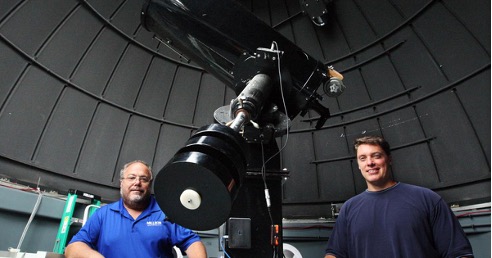
    Dan Miller (emeritus Prof. of Mathematics) and me in the Requarth Observatory.


    Millikin's Astronomy program does not end there. We have one of the largest publicly accessible telescopes in the area. In the fall and spring of the year, we host public viewing sessions, where all members of the community are welcome to stop by to do some stargazing with the assistance of qualified personnel. We also extend our reach outside of Millikin. Millikin's six 8" telescopes are portable, allowing us to go to dark sites for high-detail.

  • Making the Stars Accessible

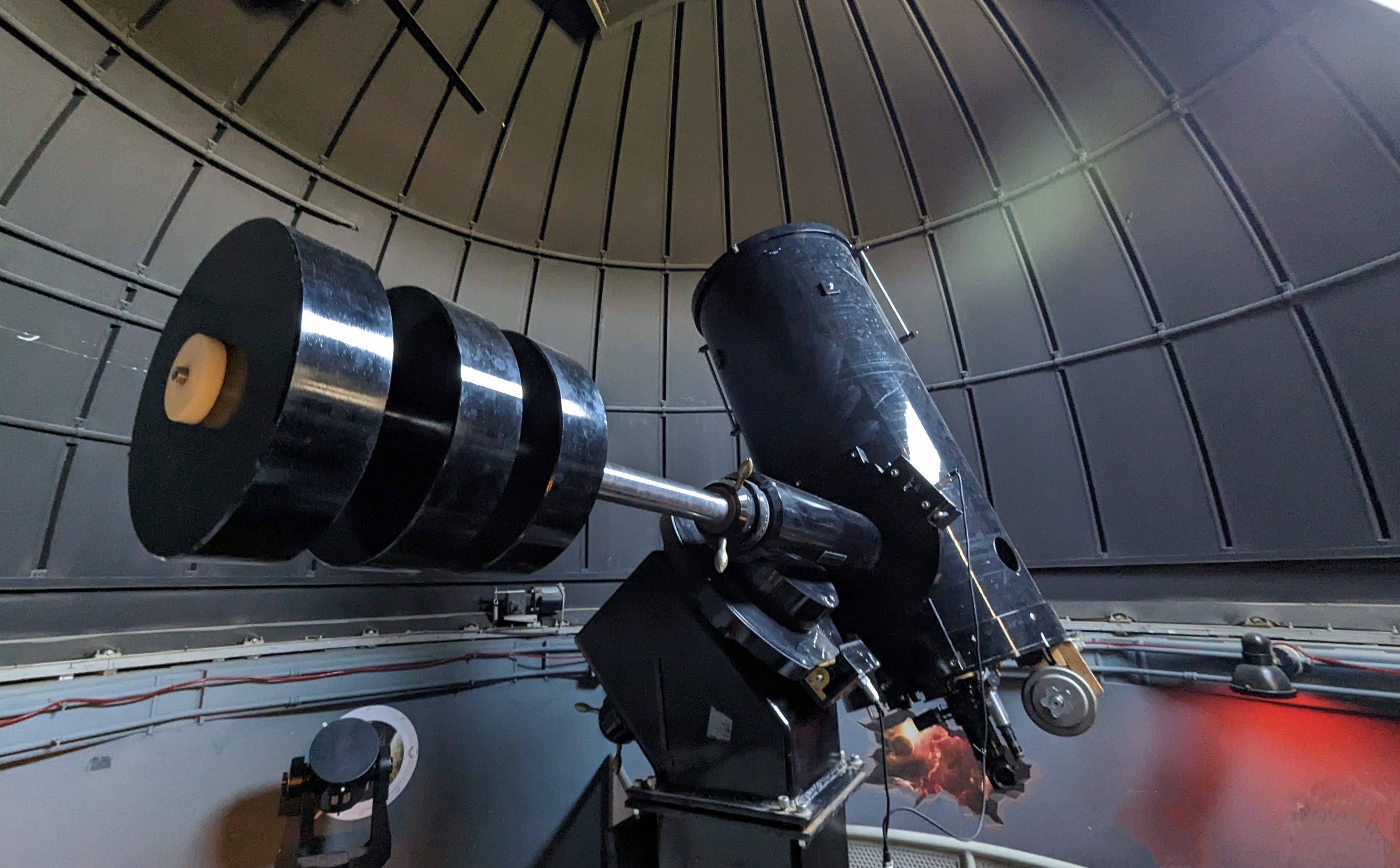
    The Requarth Observatory was built in 2000. There are three 300-pound support sections that hold the 20-foot telescope and each support had to be carried up six flights of stairs by hand. It was only after the telescope was installed that the freight elevator became operational.

    Faculty and students are continually updating the observatory to meet their scientific needs and there are currently many plans to enhance the stargazing experience for faculty, students, and visitors.

    telescope in requarth observatory


    In addition to the main telescope, the Leighty Tabor Science Building also features an observation deck on the fifth floor that surrounds the base of the dome. This observation deck provides the perfect platform to set up the smaller 8-foot telescopes that are commonly used in introductory astronomy classes. Even with a “small” telescope, it is still easy to observe the rings of Saturn.

  • Telescopes at Millikin

    Parallax Instruments 20" Ritchey-Chrétien

    Model No.PI500R, 20"
    Clear Aperture508mm
    Focal RatioF/8.1
    Focal Length4114mm
    Primary & Secondary Mirror SubstrateZero Expansion Astrositall
    Telescope TubeLow Expansion Carbon Fiber
    Secondary Amplification2.70X
    Spacing (Approx.)40"
    Mirror CoatingsAlSiO
    Optical Tube Dia.24"
    Optical Tube Length56"
    Optical Tube Weight130lbs.
    Focuser2.7"
    Finder Scope7X50
    Tube RingsStandard
    Primary Cooling FanStandard (Quantity 3)
    Slewing HandleStandard
    Tube C'wt Bar Assy.Standard (Quantity 2)


    Meade LX 200 8" Schmidt-Cassegrain

    f6.310
    Focal Length1280mm2000mm
    Aperture203mm203mm
    Secondary88mm76mm
    Obstruction43%37%
    TypeSCTSCT


    DriveFully computer controlled; 64359 object library; automatic GO TO capability
    AltazYes
    PolarYes with optional wedge
    Eyepiece26mm Plossl
    Finder8x50
    RS232Yes
    Power18v DC (AC adapter included)
    Weight41lbs41lbs
    TripodStandard


    Cameras at Millikin

    ST-7XME

    CCDKodak KAF-0402ME + TI TC-237
    Pixel Array765 x 510 pixels, 6.9 x 4.6 mm
    Total Pixels390,000
    Pixel Size9 x 9 microns
    Full Well Capactiy (ABG)~50,000 e-
    Full Well Capactiy (NABG)~100,000 e-
    Dark Current1e-/pixel/sec at 0C
    AntibloomingKAF-0402ME is NABG only ABG optional (KAF-0402LE)
    ShutterElectromechanical
    Exposure0.11 to 36000 seconds, 10ms resolution
    Correlated Double SamplingYes
    A/D Converter16 bits
    A/D Gain2.6e-/ADU
    Read Noise15e-RMS
    Binning Modes1 x 1, 2 x 2, 3 x 3
    Pixel Digitization RateUp to 420,000 pixels per second
    Full Frame Acquisition~35 seconds
    Field of View12 x 8 arcminutes on f/10 Meade LX 200
    Pixel Size.9 x .9 arcseconds on f/10 Meade LX 200
    Limiting MagnitudeMagnitude 14 in 1 second
    (for 3 arcsec FWHM stars)Magnitude 18 in 1 minute
    Cooling - standardSingle Stage Thermoelectric, Active Fan, Water Assist Ready -45 C from Ambient Typical
    Temperature Regulation+-0.1 C
    Power5 VDC at 1.5 amps, +-12 VDC at 0.5 amp desktop power supply included
    Computer InterfaceParallel
    Computer CompatibilityWindows 98/2000/Me/NT/XP
    GuidingDual CCD Self-Guiding


    STL-1001E

    Imaging CCDKodak Enhanced KAF-1001E
    Pixel Array1024 x 1024 pixels, 24.6 x 24.6 mm
    Total Pixels1.0 million
    Pixel Size24 x 24 microns
    Full Well Capacity (NAGB)200,000 e-
    Dark Curent9 e-/pixel/second at 0 degrees C
    AntibloomingNAGB only
    ShutterElectromechanical
    Exposure0.12 to 3600 seconds, 10 ms resolution
    Correlated Double SamplingYes
    A/D Converter16 bits
    A/D Gain2.0e-/ADU
    Read Noise14.8e-RMS
    Binning Modes1 x 1, 2 x 2, 3 x 3
    Full Frame Download40.8 seconds
    Cooling - standardTwo-Stage Thermoelectric, Water Assist, -40 C from Ambient Typical
    Temperature Regulation+-0.1 degrees C
    Power10-18VDC, 12VDC nominal, Universal AC to 12VDC desktop supply
    Computer InterfaceParallel
    Computer CompatibilityWIndows 98/NT/2000/Me/XP/Mac OS-X
    GuidingDual CCD Self-Guiding Standard,


    SGS-Self Guided Spectrograph

    Dispersion: 

    Two gratings available, on a carousel for rapid selction

    150 lines per mm (4.3 Angstroms per pixel)

    600 lines per mm (1.0 Angstroms per pixel)

     
    Slit Width100 microns wide Entrance Slit
    Accptance cone angle:F/6.3 by F/10
    Resolution: 
    Narrow slit & 600 lines/mm2.4 Angstroms
    Narrow slit & 150 lines/mm10 Angstroms
    Wide slit & 600 lines/mm10 Angstroms
    Wide slit & 150 lines/mm38 Angstroms
    Relative Sensitivity to Diffuse Sources: 
    Narrow slit & 600 lines/mm1.0
    Narrow slit & 150 lines/mm4.0
    Wide slit & 600 lines/mm4.0
    Wide slit & 150/mm16.0
    Dispersion:1.07 or 4.3 Angstroms per pixel
    ResolutionEmission line is recorded with 2.4, 10 or 38 Angstroms Full Width at Half Maximum
    Spectral coverage per frameAbout 750 Angstroms with the high resolution grating, or 32000 with the low resolution grating
    Center Wavelength SelectionCalibrated Micrometer Adjustment
    Wavelenght Range3800 to 7500 Angstroms
    SensitivitySignal to noise ration of 10:1 for a 9th mag star, 20 minute exposure using a non-AGB ST-7 and a 10 inch (25 cm) apertaur in high resolution mode. An ABG ST-7 will reach magnitude 8. The low resolution mode will be 1.5 magnitudes more sensitive.
    Entrance Slit18 micron (2.3 arcseconds wide with 63 inch focal length telescope or 72 microns
    Uses:

    Stellar Classification

    Analysis of Nebular Lines

    Indentification of spectroscopic binaries

    Measurement of Stellar proper motion to +/- 6km/sec accuracy

    Measurement of Emission Nebula Proper Motions

    Spectra of Laboratory and field sources

  • External Links

    Professional Organizations 
    American
    Association of
    Physics Teachers
    The offical site for AAPT
    American Astronomical
    Society
    The offical site for AAS
    American Physical SocietyThe offical site for APS
    Society of Physics StudentsThe offical site for SPS
    Physics and General Science 
    Physics TodayThe latest news in physics
    EurekAlert!Science news that is only a
    click away
    Astronomy Picture of the Day (APOD)A new photo each day with
    an explanation by a
    professional astronomer
    Locations and Facilities 
    National Radio Astronomy ObservatoryA system of Radio
    Telescopes world-wide
    Software, Hardware, and Maps 
    The Mag-7 Star Atlas Project A free online site which
    provides detailed star
    charts up to 7th magnitude
    objects
    StellariumA free open source
    planetarium for your
    computer
    SBIGAstro-camera, computer
    software, and instructions
    on how to use both
    Starry NightSoftware which is helpful
    both all levels of
    astronomers